

Japan's first municipal Decidim: six years of participation, from a Smart City vision to redesigning the station area
Kakogawa City (Hyogo Prefecture, pop. ~260,000) launched Japan's first municipal Decidim in October 2020. Across 25 participatory processes it has co-created its Smart City Vision, published progress on every measure, let residents name a new public facility by vote, and opened the redesign of the main station area and the next Comprehensive Plan to public input
Kakogawa instance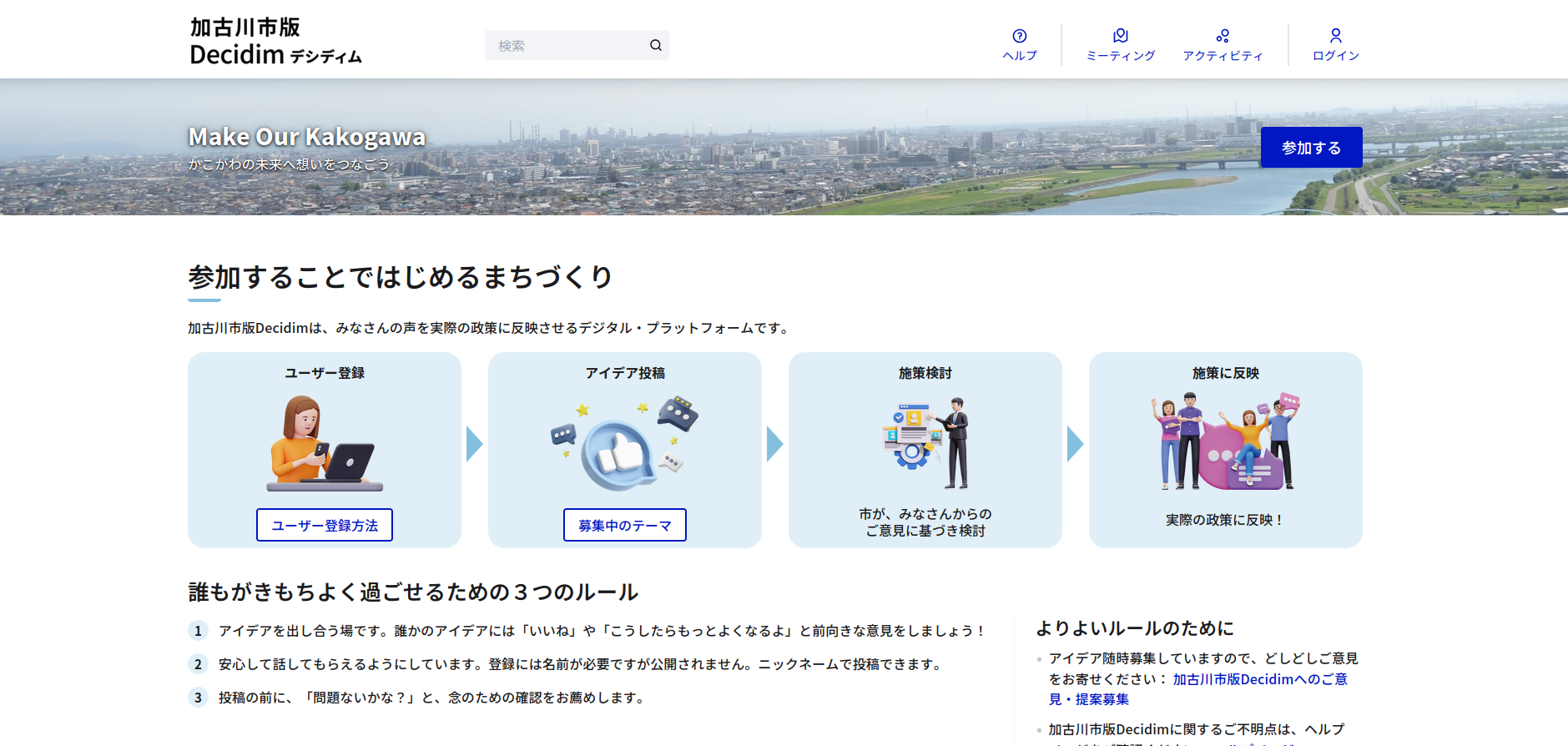
Type of process
Participatory Policy-Making
Target public
All residents; posting is under a nickname and real names are never shown. Kakogawa deliberately does not enforce a strict residency rule — for example, students who commute to high schools in the city from neighbouring towns are treated as important future stakeholders. Individual processes target specific groups: older people (smartphone support), high-school students (Comprehensive Plan workshops), and landowners and businesses around the station.
Components used
- Debates
- Proposals
- Blogs
- Accountability
- Meetings
- Pages
- Surveys
- Voting
- External 3D city-model / AR pages
Results
7,416 registered users
25 participatory processes; 15 assemblies
540 proposals (148 accepted)
3,259 comments, 387 votes, 66 debates, 20 accountability results
3
Shortlisted on Decidim
The instance has won a series of awards: Manifesto Award 2021 (Communication Strategy), Japan DX Award 2022 (Microsoft Prize)
Why did you choose Decidim?
First, Decidim was open-source software and Code for Japan is a community that promotes public-private partnerships through open data and open-source software.
Second, Decidim was very actively updated among other tools that checked. Third, Decidim provides customize-friendly architecture so that we can adapt it to our domestic situation.
Participatory process design
Smart City Vision (2020–21)
→ Idea collection (30 Oct–27 Nov 2020, three debates matching the three policy pillars)
→ Opinion collection on the redrafted principles (7–18 Dec)
→ public comment on the draft (7 Jan–5 Feb 2021).
Two in-person meetings were held between the online phases to converge the discussion. Since adoption, a dedicated process publishes 17 accountability results plus annual meetings and blog reports.
1
Smart City Vision (2020–21)
→ Idea collection (30 Oct–27 Nov 2020, three debates matching the three policy pillars)
→ Opinion collection on the redrafted principles (7–18 Dec)
→ public comment on the draft (7 Jan–5 Feb 2021).
Two in-person meetings were held between the online phases to converge the discussion. Since adoption, a dedicated process publishes 17 accountability results plus annual meetings and blog reports.
Naming "Kakoterasu" (2021)
→ Crowd-sourced names
→ shortlist
→ Decidim vote
→ offline sticker ballots → decision
Until the facility opened, construction updates and opening events were shared on the same process so that voters felt ownership of "their" building.
2
Naming "Kakoterasu" (2021)
→ Crowd-sourced names
→ shortlist
→ Decidim vote
→ offline sticker ballots → decision
Until the facility opened, construction updates and opening events were shared on the same process so that voters felt ownership of "their" building.
Kakogawa Station area (2022–2028)
→ Vitalisation ideas (decarbonisation, pilot events, "ideal station area": Debates, Proposals, Accountability)
→ 2024 workshops using a 3D city model and AR (two in-person sessions with an online idea call in between; each group's design was embedded as a web page and put to a comment vote)
→ 2025–28 Redevelopment Basic Plan (principles → workshops, trials and surveys on how people want to use the space → plan).
3
Kakogawa Station area (2022–2028)
→ Vitalisation ideas (decarbonisation, pilot events, "ideal station area": Debates, Proposals, Accountability)
→ 2024 workshops using a 3D city model and AR (two in-person sessions with an online idea call in between; each group's design was embedded as a web page and put to a comment vote)
→ 2025–28 Redevelopment Basic Plan (principles → workshops, trials and surveys on how people want to use the space → plan).
Next Comprehensive Plan (2025–27)
→ High-school students workshop (Mar 2025)
→ citizens' deliberation forum with Hyogo University (Jul 2025)
→ each event reported on Blogs and opened for comments → call for citizen committee members and public comment.
4
Next Comprehensive Plan (2025–27)
→ High-school students workshop (Mar 2025)
→ citizens' deliberation forum with Hyogo University (Jul 2025)
→ each event reported on Blogs and opened for comments → call for citizen committee members and public comment.
Digital inclusion (2021–26)
From beginner support to a "mutual help" phase: residents share how they help family and neighbours use smartphones (Proposals); staff outreach classes are reported on Blogs.
5
Digital inclusion (2021–26)
From beginner support to a "mutual help" phase: residents share how they help family and neighbours use smartphones (Proposals); staff outreach classes are reported on Blogs.
Impact
Interesting facts about it
- "Kakoterasu" was chosen by residents and is the facility's official name
- The Smart City Vision was adopted and 17 measures are tracked in public
- Services that started as residents' proposals: a shared-bicycle service, digital signage at bus stops, and a digital stamp rally through the shopping streets
- A high-school students' proposal — promoting the city's local sock industry as a gift of gratitude to family — was refined with pro-bono support from NEC employees and is being run by the students themselves (outside the municipal budget)
- Strong participation by young people (about 40% of early participants were teenagers)
Meetings and engagement
The pattern is "collect widely online, converge in person, then widen again." In-person workshops (3D/AR, students, deliberation forum, station area) alternate with online idea calls, and every workshop result is published as a meeting or blog post. For six years the secretariat has replied individually to residents' comments and reported back the changes made — for example, improving a community-watch app's guidance page after user feedback. Offline activities such as outreach classes and street trials are also documented on the platform.
Innovations
- Japan's first municipal Decidim; the Japanese localisation was produced jointly by the city and Code for Japan
- LINE login to lower the registration barrier
- Workshops that connect a 3D city model and AR tools with Decidim comment votes
- Accountability used continuously for six years to publish the progress of every measure of the Smart City Vision
- A standing process inviting suggestions about the platform itself, feeding UI/UX improvements
Lessons learned
- Improve the platform step by step with each Decidim upgrade. Over six years Kakogawa moved from localisation to LINE login, custom content blocks and Decidim 0.30, treating each version as an opportunity for UI/UX improvement.
- Do not leave it to the digital team alone. Line departments — station redevelopment, comprehensive planning, tourism, welfare — open and run their own processes, while the Digital Reform Division maintains the platform. This is what keeps the site alive.
- Online works as a "24-hour notice board" to gather voices; convergence happens face to face. Installing Decidim is easy; being an organisation that can use it is the real test.
Testimonial
- Kakogawa City's Decidim page: https://www.city.kakogawa.lg.jp/soshikikarasagasu/kikakubu/jouhouseisakuka/ict_1/36257.html
- Column by the city's Smart City team (Seijiyama, Aug 2022): https://seijiyama.jp/article/columns/lm/lm20220815.html
- Interview with Mayor Okada (Nikkei BP, Jan 2025): https://project.nikkeibp.co.jp/atclppp/021900032/112600031/
Partners
Code for Japan (operated by Kakogawa City, Digital Reform Promotion Division)